
Homepage › Old Turkic texts › Küli Chor inscriptions
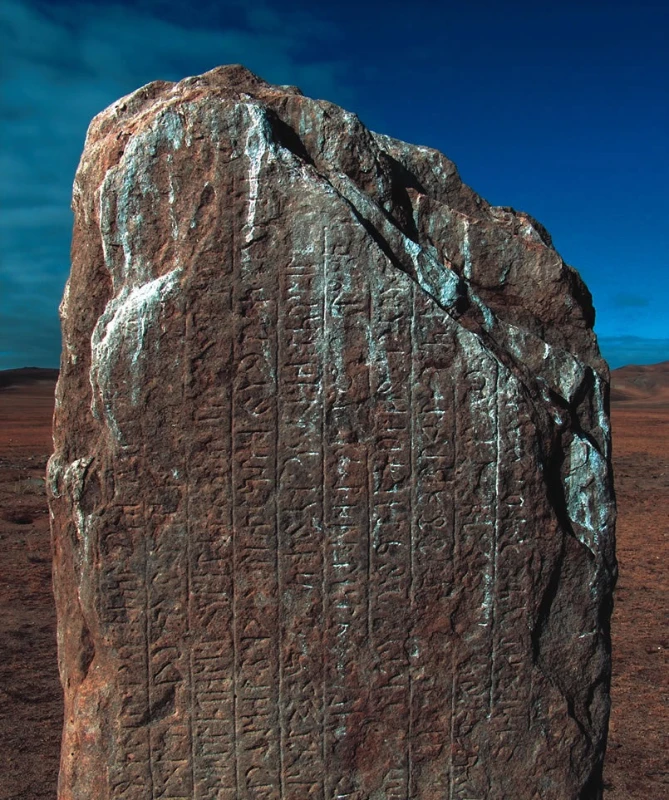
Küli Chor inscriptions
In 630, the Eastern Türk Empire was defeated by Tang China and collapsed. After more than half a century, Kutluğ rallied the Turks in 682 and succeeded in re-establishing the empire, thus founding the Second Gök Türk Empire and assuming the title Elteriş Kağan. Under his successors, Kapğan Kağan and Bilgä Kağan, the Turks conducted numerous military campaigns to expand and consolidate their power across Central Asia.
Among the prominent military commanders of this period was Küli Çor, who bore the title Işbara Bilgä Küli Çor and governed the Tarduş, the western division of the empire. He participated in campaigns against Tang China, the Türgiş, the Oğuz and the Karluks. According to the inscription, he eventually lost his life in battle, and his funeral was attended by several members of the ruling family.
The Küli Çor inscription, generally dated to the early eighth century, commemorates his military achievements, courage and service to the empire. Unlike the inscriptions of Kültegin and Bilgä Kağan, it offers a perspective on the history of the Gök Türk Empire centred on a senior military commander rather than a member of the ruling dynasty. The monument was discovered in 1912 by the Polish scholar Władysław Kotwicz at Ikh Khöshööt in present-day Mongolia.
Reading settings
Bibliography 11
-
Erhan Aydın (2019) Name, Titles, and Identity in the Küli Čor Inscription
-
Osman Mert (2015) Köli Çor Yazıtı ve Anıt Mezar Kompleksi
-
Нәпіл Базылхан (2005) Қазақстан тарихы туралы түркі деректемелері 2: Көне түрік бітіктастары мен ескерткіштері (Орхон, Енисей, Талас)
-
Talat Tekin (2003) Orhon Türkçesi Grameri
-
Қаржаубай Сартқожаұлы (2003) Орхон мұралары
-
林俊雄, 大澤孝 (1999) イフ=ホショートゥ遺蹟とキュリ=チョル碑文
-
Hüseyin Namık Orkun (1994) Eski Türk Yazıtları
-
Gerard Clauson, Edward Tryjarski (1971) The Inscription at Ikhe Khushotu
-
Talat Tekin (1968) A Grammar of Orkhon Turkic
-
Сергей Малов (1959) Памятники древнетюркской письменности Монголии и Киргизии
-
Władysław Kotwicz, Alexandre Samoïlovitch (1928) Le monument turc d’Ikhe-Khuchotu en Mongolie centrale


