
𐰴𐰍𐰣
χagan
Meaning:
ruler, king, khagan, khan
xağan is an ancient royal title, meaning “independent ruler, sovereign ruler of a people or tribe” in Old Turkic. It is first clearly attested as a royal title around the 4th–5th centuries. In Old Turkic and Uyghur texts it is usually written kağan, but since the script did not distinguish k- and x- in this position, Clauson and Erdal consider xağan the more probable form. Its relationship to xa:n “ruler, khan” is uncertain; the two are semantically close but cannot be morphologically connected within Turkic. The title was borrowed early into Mongolian as kağan / ka’an and into Islamic usage as Arabicized xāqān, where it remained an imperial title, including in Ottoman titulature in which it remained one of the imperial titles until the dissolution of the Ottoman Empire.
Alternative spellings:
𐽲𐽰𐽲𐽰𐽺
خاقانْ
Antonyms:
Related:
Word family
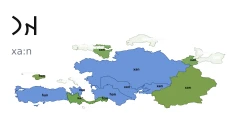
In modern languages (12 / 22)
Select a region to see the cognate.
| Language | Cognate |
|---|---|
| Turkmen | han |
| Turkish (Azerbaijan) | xan |
| Turkish (Türkiye) | han |
| Salar | No cognate has been entered for this language yet. |
| Gagauz | han |
| Crimean | han |
| Uyghur | xan |
| Uzbek | xon |
| Kazakh | xan |
| Nogai | No cognate has been entered for this language yet. |
| Siberian Tatar | No cognate has been entered for this language yet. |
| Kyrgyz | xan |
| Altai | xan |
| Alan | No cognate has been entered for this language yet. |
| Kumyk | No cognate has been entered for this language yet. |
| Tatar | No cognate has been entered for this language yet. |
| Bashkir | xan |
| Tıva | No cognate has been entered for this language yet. |
| Khakas | No cognate has been entered for this language yet. |
| Sakha (Yakut, Dolgan) | xaan |
| Khalaj | No cognate has been entered for this language yet. |
| Chuvash | No cognate has been entered for this language yet. |
Examples
Translations
German:
Herrscher, König, Kaiser, Khagan, Khan
Russian:
правитель, царь, каган, хан
Turkish (Azerbaijan):
padişah, xaqan, xan
Turkish (Türkiye):
hükümdar, padişah, kral, kağan, han
Bibliography 1
-
Gerard Clauson (1972) An etimological dictionary of pre-thirteenth-century Turkish611611
F xağan a title of great antiquity taken over by the Türkü in the specific sense of ‘an independent ruler of a tribe or people’. Its earlier history is discussed by Pulleyblank in Asia Major IX, Part 2, pp. 260 ff. It is first noted in an immediately recognizable form as a royal title of the Juan-juan and T’u-yü-hun round about A.D. 400, but Pulleyblank believes that a Hsiung-nu royal title hu-yü (Ancient Chinese ywax-ywäy) mentioned in connection with events at the end of the 1st century B.C. is an earlier Chinese transcription of the same word. In Türkü and Uyğ. texts it is habitually transcribed kağan, but as both x- and k- would have been represented by the same letter in these texts it was almost certainly xağan. The relationship between it and xa:n, which is practically syn. w. it, is obscure; the two cannot morphologically be connected in Turkish but may have been alternative forms in the languages from which they passed to Turkish. It became an early l.-w. in Mong. as kağan/ka’an (Haenisch 54-6) and re-entered Çağ. in the latter form. It was Arabicized as xāqān at an early date and in that form remained one of the imperial titles until the dissolution of the Ottoman Empire. Türkü viii xağan is very common; it is normally used of the Türkü ruler himself, but also of the Emperor of China, tavğaç xağan I N 12, the King of Tibet Tüpüt xağan I N 12, and junior members of the royal family installed as the rulers of subject Turkish tribes, Türgeş xağan, Kırkız xağan I N 13: Uyğ. viii xağan was the title assumed by Uyğ. rulers when they became independent in A.D. 742 Şu. I N 1, etc.: viii ff. Bud. adınçığ ıduk xağan xan süsi ‘the army of our elect, sacred ruler (Hend.)’ TT VII 40, 123-4: xiv Chin.-Uyğ. Dict. huang ti ‘Emperor’ (Giles 5,106 10,942) xağan Ligeti 160; R II 71: Xak. xi (under xa:n) it is the title given to the descendants of Afrāsiyāb, wahwa’l-xāqān, it is used both in the short and the long form Kaş. III 157: KB xa:ka:n is the title given to the poet’s patron 85-6, 102-4, 115: xiv Muh. al-malik ‘king’ xa:ka:n Mel. 50, 4; Rif. 145 (in margin xa:n): Çağ. xv ff. ka’an (also a Pe. word) xāqān wa xān Vel. 313 (quotns.); ka’an şāh-i şāhān ‘king of kings’; in this connection the Mongols call their own supreme Emperor (pādişāh) to whom other pādişāhs are subject ka’an San. 263v. 8; xakan alternative form (murādif) of ka’an that is ‘king of kings’ (quotn.); and they call Emperors in general and the Emperor of China in particular xakan 222r. 23 (followed by a list of other royal titles).

