
*𐰖𐰉
*yav
Meaning:
(reconstructed) bad, poor, defective
*yav is a reconstructed nominal or adjectival base and is not independently attested in Old Turkic. It has been proposed as the common base of yavız “bad” and yavlak “bad, evil”. A nominal yav is directly attested much later, in seventeenth-century Chagatai, with the meaning “enemy”; related forms in later Turkic languages likewise support the former existence of such a stem, although they do not establish its exact prehistoric meaning.
The etymology of this word family is disputed:
- Vámbéry, Dankoff–Kelly: derive yavız from a nominal base *yav or *yab, but without a fully established derivational analysis.
- Bang, Clauson, Gülensoy: connect yavız with a hypothetical verb *yav-. Clauson, however, derives yavlak separately from a homophonous nominal *yav through a denominal verb.
- Räsänen: connects yavız with forms such as yabı and yabu “lean, poor, bad”, without establishing the derivational morphology.
- Tekin and Erdal: seek the origin of yavız in forms containing r, respectively *yavır and yavrı-, involving the Turkic r ~ z correspondence.
- Topuz: proposes a single nominal base *yab > *yav, with *yab + I- + -(X)z → yavız and *yab + lA- + -(O)k → yavlak. Akdemir and İsi likewise favour an analysis *yav + lA- + -(O)k for yavlak.
- Starostin–Dybo–Mudrak: reconstruct a broader Proto-Turkic *jAb- complex with meanings around “bad, coarse, wicked; become bad or weak; difficult, severe; insipid”, grouping yavız, yavlak and several related forms under one prehistoric root.
A single-root analysis is therefore attractive: *yav may be taken as the reconstructed nominal/adjectival base of the family, while the exact formation of yavız remains disputed; yavlak can more regularly be analysed as *yav + lA- + -(O)k. A vowel-final variant *yava is also conceivable in view of Azerbaijani yava and yavalaş-, and a development *yavalak → yavlak through medial vowel loss would be phonologically possible. However, no such *yava is attested in Old Turkic, so this should remain a possible rather than the preferred reconstruction.
Word family
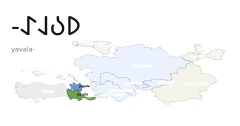
In modern languages (0 / 22)
Select a region to see the cognate.
| Language | Cognate |
|---|---|
| Turkmen | The cognate has disappeared from this language. |
| Turkish (Azerbaijan) | The cognate has disappeared from this language. |
| Turkish (Türkiye) | The cognate has disappeared from this language. |
| Salar | The cognate has disappeared from this language. |
| Gagauz | The cognate has disappeared from this language. |
| Crimean | The cognate has disappeared from this language. |
| Uyghur | The cognate has disappeared from this language. |
| Uzbek | The cognate has disappeared from this language. |
| Kazakh | The cognate has disappeared from this language. |
| Nogai | The cognate has disappeared from this language. |
| Siberian Tatar | The cognate has disappeared from this language. |
| Kyrgyz | The cognate has disappeared from this language. |
| Altai | The cognate has disappeared from this language. |
| Alan | The cognate has disappeared from this language. |
| Kumyk | The cognate has disappeared from this language. |
| Tatar | The cognate has disappeared from this language. |
| Bashkir | The cognate has disappeared from this language. |
| Tıva | The cognate has disappeared from this language. |
| Khakas | The cognate has disappeared from this language. |
| Sakha (Yakut, Dolgan) | The cognate has disappeared from this language. |
| Khalaj | The cognate has disappeared from this language. |
| Chuvash | The cognate has disappeared from this language. |
Examples
No corpus links yet.
Translations
German:
(rekonstruiert) schlecht, minderwertig, mangelhaft
Russian:
(реконструкция) плохой, негодный, ущербный
Turkish (Azerbaijan):
(bərpa olunmuş) pis, yaman, yava
Turkish (Türkiye):
(yeniden kurulmuş kök) kötü
Bibliography 2
-
Sergei Starostin, Anna Dybo, Oleg Mudrak (2003) Etymological Dictionary of the Altaic Languagespp. 466–467pp. 466–467
*debí (~ ǯ-) bad, to suffer: Mong. *ǯib-; Turk. *jAb-; Jpn. *(d)impi-r-; Kor. *jəbúi-.
PMong. *ǯib- aversion, disgust, indignation (отвращение, негодование): WMong. ǯibegüü, ǯebegüü (L 1048); Kh. ǯivǖ(n), ʒevǖ(n); Bur. zebǖ(n) ‘arrogant, proud’.
◊ Mong. > Evn. ǯöbēnŋъ ‘austere, serious’ (ТМС 1, 266).
PTurk. *jAb- 1 bad, coarse, wicked 2 to become bad, weak 3 heavy, difficult, severe 4 tasteless, insipid (1 плохой, грубый 2 ухудшаться, слабеть 3 тяжелый, трудный, суровый 4 пресный, безвкусный): OTurk. jabɨz 1 (Orkh.), javɨz 1 (OUygh.), javɣan 1 (OUygh.), jablaq (Orkh.) 3, javlaq (OUygh.) 3; Karakh. javrɨ- 2, javra- ‘to become rough, coarse’, javɨz 1, javɣan 1, javlaq 3 (MK); Tur. javuz 1, javan 4; Gag. javan 4; Az. javan 4; Turkm. jovuz 1, 3, juwan 4 (dial.); MTurk. javlaq (R) ‘very’, javuz (Ettuhf., AH) 1; Uzb. jɔwuz 1, jōɣan 4 (dial.); Uygh. javuz 1; Tat. jawɨz 1; Bashk. jawɨδ- 1; Kirgh. ǯūɣan 4; Kaz. ǯawɨz 1; KKalp. ǯawɨz 1; SUygh. jus 1; Khak. čaɣban 4; Yak. suos 3.
◊ VEWT 176, EDT 879, 881-882, ЭСТЯ 4, 47-48, 51. Turk. > WMong. ǯabqai, ǯabaɣan (KW 468), whence again some Turkic forms (Kirgh. ǯabɨq etc., see ЭСТЯ 4, 9-10). One could perhaps also note Kaz. ǯawra-, Uzb. ǯɔwra- ‘to suffer from cold, shiver’ (ЭСТЯ 4, 20) which may be = Karakh. javra-, javrɨ- and thus should not be compared to Mong. daɣara- (despite KW 82).
PJpn. *(d)impi-r- to oppress (угнетать): MJpn. ibir-; Tok. ibir-.
PKor. *jəbúi- to get emaciated, haggard (истощаться, становиться изможденным): MKor. jə’úi-, jə’ói-; Mod. jəwi-.
◊ Liu 563, KED 1165.
‖ Finch 1987, 17 (Jpn.-Mong.). One of the few exceptional cases of *ǯ- > *j- in Kor. (cf. *ǯu ‘eight’). -
Gerard Clauson (1972) An etimological dictionary of pre-thirteenth-century Turkishp. 871bp. 871b
*yav- See yavğa:n, yavrı:-, yavız.


