
𐰏-
äg-, äŋ-
Meaning:
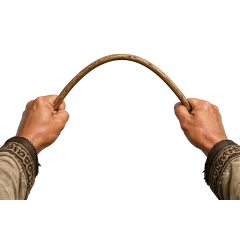
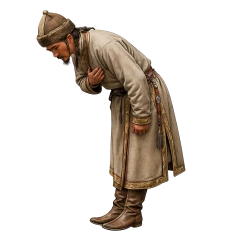
to bend
Used primarily of bending something physically, and at times, with “head” or “neck” understood, of bowing. The two spellings äg- and äŋ- are generally treated as different realizations of the same root, though the original form is debated. Many scholars reconstruct Proto-Turkic eg-, while an alternative reconstruction eŋ- has also been proposed; according to Róna-Tas, eŋ- is not merely a variant, but the older form, and both go back to an earlier äŋ?-.
Alternative spellings:
𐽰𐽷
Word family
In modern languages (14 / 22)
Select a region to see the cognate.
| Language | Cognate |
|---|---|
| Turkmen | eg- |
| Turkish (Azerbaijan) | əy- |
| Turkish (Türkiye) | eğ- |
| Salar | No cognate has been entered for this language yet. |
| Gagauz | No cognate has been entered for this language yet. |
| Crimean | No cognate has been entered for this language yet. |
| Uyghur | eg- |
| Uzbek | eg- |
| Kazakh | iy- |
| Nogai | iyu- |
| Siberian Tatar | No cognate has been entered for this language yet. |
| Kyrgyz | iy- |
| Altai | iy- |
| Alan | No cognate has been entered for this language yet. |
| Kumyk | No cognate has been entered for this language yet. |
| Tatar | No cognate has been entered for this language yet. |
| Bashkir | ey- |
| Tıva | e- |
| Khakas | No cognate has been entered for this language yet. |
| Sakha (Yakut, Dolgan) | iex- |
| Khalaj | əy- |
| Chuvash | av- |
Examples
Translations
German:
krümmen, biegen
Russian:
сгибать
Turkish (Azerbaijan):
əymək
Turkish (Türkiye):
eğmek
Bibliography 4
-
Dr. Jens Wilkens (2021) Handwörterbuch des Altuigurischen | Eski Uygurcanın El Sözlüğü1091091äŋ- krümmen || bükmek; bekehren || döndürmekäg- ınandur- bekehren und Zuflucht nehmen lassen || döndürmek ve çare aratmak
-
András Róna-Tas, Árpád Berta, László Károly (2011) West Old Turkic: Turkic Loanwords in Hungarian319-320319-320---
-
Gerard Clauson (1972) An etimological dictionary of pre-thirteenth-century Turkish99-10099-100
eg- ‘to bend (something Acc.)’; occasionally, with ‘head’ or ‘neck’ understood, ‘to bow’. C.i.a.m.l.g. A syn. word eg-, included here, occurs so sporadically that it is not clear whether it is a Sec. f. of eg- or an independent word, but, the Caus. f. eğit-, so spelt in TT VIII, makes it clear that the occurrences in Uyğ. are intended to represent eg- and not, as might otherwise have been supposed e:g-. Eg- survives in NE Alt., Tel. eg- R I 710; Bar. ig- R I 431: NC Kir. eg-. Cf. eğil-, egin. Uyğ. viii ff. Bud. iki suk egreklerni egip ‘bending the two index fingers’ U II 46, 71-2; iki yanar ergek egip ditto TT V 8, 57; üç ergek ayada eg(g)il . . . yanar ergek egdü teg ege tutğıl ‘fold three fingers in the palm of the hand . . . bend the index finger in the shape of a curved knife’ do. 12, 119-21: Xak. xi ol butak egdi: ‘he bent’ ('atafa) ‘the bough’ Kaş. I 168 (ege:r, egme:k); ta:ğığ u:krukin egme:s ‘you cannot bend’ (yuhanni) ‘a mountain with a lasso’ I 100, 18: KB yağı boynı egdi ‘he bent the enemy’s necks’ 101; (the enemy heard and) boyun eğdiler ‘bowed their necks’ 450; a.o.o.: xiii(?) At. eğilmez kögülni akılık eger ‘generosity bends the unbending mind’ 233: xiv Muh.(?) taw’a taqayn ‘to fold in two’ eg- Rif. 112 (only): Çağ. xv ff. eygen dür (sic, under a-y, but ?read eg(g)en dür) mayi wa muhabbat eyledi ‘he bowed and showed love’ Vel. 41 (quotn.); eğ- (‘with -g-’) xam kardan ‘to bend’ San. 106v. 29 (quotns.): Xwar. xiv eg- ‘to bend’ Qutb 57: Kom. xiv ‘to bow’ eg- (sic) CCG; Gr.: Kıp. xiii 'awwaca ‘to bend’ eg- Hou. 42, 10: xiv eg- (‘with -g-’) ditto İd. 18: xv fatala ‘to twist’ ey- Tuh. 28b. 6. -
M Räsänen, I Kecskeméti (1969) Versuch eines etymologischen Wörterbuchs der Türksprachen37-3837-38---





